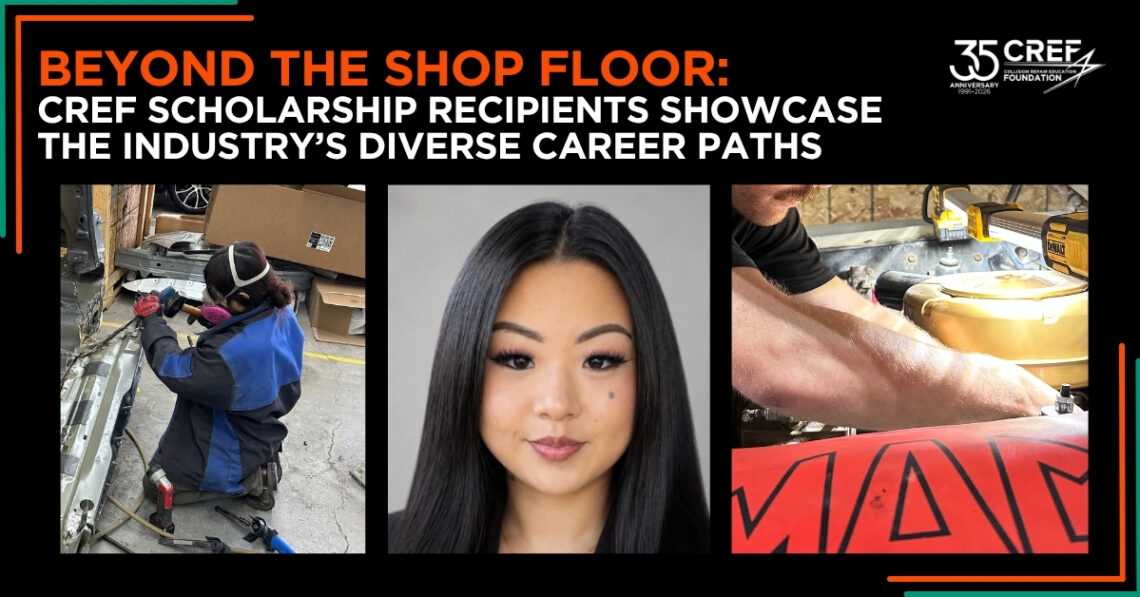
Beyond the Shop Floor: CREF Scholarship Recipients Showcase the Industry’s Diverse Career Paths
Written for the Collision Repair Education Foundation
For years, a common misconception has lingered around automotive trade schools: the belief that a collision repair career begins and ends on the shop floor. That’s far from reality; today’s collision repair industry reaches far beyond the repair bay, creating opportunities in product development, technical training, research, OEM programs, management and entrepreneurship. The modern collision landscape has evolved into a dynamic ecosystem where corporate research labs, manufacturer-specific tech centers, independent repair facilities and custom restoration shops all rely on the same foundational skill set. A degree in this field is not a cage – it is a launchpad into a rewarding career!
To showcase this shifting landscape, the Collision Repair Education Foundation (CREF) caught up with several recent scholarship recipients. Their diverse professional paths demonstrate exactly how far a collision career can go, especially when fueled by early industry support.
For Mikayla Hoth, a 2024 CREF and Women’s Industry Network (WIN) scholarship recipient, the journey into collision repair began as a creative pivot. She had initially pursued business, marketing and communications at a traditional university, but she had always been attracted to more artistic endeavors and couldn’t envision spending her career behind a desk. After learning about the collision repair program at Dunwoody College of Technology, she decided to take a chance. “Once I started learning collision repair, I fell in love with automotive painting,” she said.
While working as a prepper and painter at local shops, Hoth focused heavily on networking, and her visibility at trade events eventually caught the attention of an industry mentor. In turn, that connection opened the door to a corporate role at 3M Headquarters, where she now works as a contracted technician. Instead of fixing customer vehicles, she spends her days in a corporate lab, testing new paint gun products, working with advanced abrasives and polishing systems, painting testing panels and assisting with student training events.
Changing career paths meant leaving a traditional university to start over at a technical college – a decision her family fully supported, but one that came with new expenses and financial challenges, including the cost of specialized equipment, books and welding supplies. Scholarships from CREF and WIN helped bridge that gap, allowing Hoth to focus on developing her skills instead of worrying about how she would afford the tools and materials required for the program. Many of those same tools remain part of her professional toolkit today.
The scholarships provided more than financial support. Through CREF, WIN and industry events, Hoth also built a network of mentors who broadened her view of the collision repair industry and continue to encourage her career growth. “Networking is one of the most important things you can do when you first enter this industry,” she insists. “I’ve met so many amazing people who’ve supported my career aspirations.”
Those relationships ultimately broadened her perspective on what a collision repair education could offer. While she enjoyed painting in the shop, conversations with industry professionals opened her eyes to opportunities beyond the booth. “When I was painting, I thought that’s what I’d do for the rest of my career, but when someone introduced me to opportunities at 3M, it completely changed my perspective. A collision repair education doesn’t lock you into one job. You can become a technician, a painter, a trainer, a manufacturer’s representative or move into product development and testing like I did. I always encourage students to attend industry events and keep an open mind because you never know where those connections might lead.”
Today, Hoth is focused on expanding her technical expertise from an entirely different perspective. “One of my biggest goals at 3M is learning everything I can about the products themselves. When you’re working in a shop, you know how to use them, but you don’t always learn how they’re developed or tested. Being here has allowed me to deepen my knowledge of every aspect of the products, and that’s made me a better professional.”
Hoth also hopes to help pave the way for more women entering the field. “One of my goals is to advocate for women in collision repair and demonstrate that this industry is made for us as well,” she stresses. “Through WIN and other networking opportunities, I’ve met so many inspiring women who are willing to answer any question I have. It can be difficult for women to pursue a career in this ‘man’s world’ because there are still some men who don’t want us here, but knowing I have a safe space with supportive women who would move all the stars in the sky to help me succeed has made a huge difference.” Today, she pays that support forward by mentoring young women at career days and encouraging them to explore the many career paths the collision repair industry has to offer.
While Hoth leverages her training in a research and development environment, other graduates find their calling by specializing in high-end, manufacturer-specific artistry. Johnathan Brachfeld, another 2024 scholarship recipient, was inspired to enter the field as a teenager after seeing the successful life his high school friend’s father had built as a shop owner. He went to work at that shop when he was 17 years old, and then his path led him to the Universal Technical Institute in Houston for a formal collision repair education. After graduation, Brachfeld took the competitive next step of entering the specialized BMW STEP program to master advanced prepping, masking and painting techniques. Today, he applies those skills as a refinish technician at a Tesla Collision Center in Tampa, Florida, where he works on one of the industry’s fastest-growing vehicle segments using OEM repair procedures.
The CREF scholarship provided Brachfeld with immediate practical relief during a financially stressful transition. “It definitely motivates you to get nice tools, which keeps you consistent and dedicated to your career,” he explains, noting that he was relying heavily on credit cards before the funding arrived. Having recently received a second tier of tool awards specifically tailored to painting, he has been able to build the premium inventory required to work on cutting-edge electric vehicles, demonstrating how technical specialization leads directly to elite, manufacturer-backed employment.
Of course, the backbone of the industry remains the local repair facility, where the next generation of independent technicians is already making an impact. Annabelle Hernandez Guerrero, a 2025 scholarship recipient from Metropolitan Community College, discovered her passion when she successfully replaced the bumper on her very first car. Recognizing that her sharp attention to detail could take her far, she took a job detailing cars to get her foot in the door before earning a formal structural repair apprenticeship.
Now working as an apprentice body technician at Dingmans Collision Center in Omaha, Nebraska, Hernandez Guerrero credits her formal education with giving her the confidence to thrive in a fast-paced shop environment just a few months into her program. The financial support from CREF has functioned as a strategic bridge to her financial independence, allowing her to save and invest systematically in the heavy tool inventory required to eventually become a standalone technician. “I could not be more grateful! The scholarship from CREF has helped me out so much by helping with school costs and tools. It removed a lot of stress off my shoulders and helped me create a gameplan to determine which tools I’ll buy next. I can’t wait to see what the future brings!”
And Hernandez Guerrero is certain that there is a future in this career path as she points out that the hands-on nature of the trade offers a level of career stability that is becoming increasingly valuable for today’s workforce. “This career cannot be replaced by AI, which brings great peace of mind,” she notes. “And if you ever feel like a role isn’t for you, there are so many options – whether you look in the shop, the front office or explore a management track where you can grow with a company. Just find what makes you happy and give it your best.” Her ultimate dream is to master her craft on the floor and become an A-Tech before one day opening her own repair facility.
While Hernandez Guerrero is building her future inside a traditional collision center, another scholarship recipient has combined collision repair with mechanical expertise to pursue an entirely different vision. Matthew Hensel, a 2024 scholarship recipient from Iowa Central Community College, was initially drawn to the trade by watching automotive restoration shows on television. Because he already possessed a strong mechanical background, he decided to return to school for collision repair to become a dual-threat professional.
Hensel has since applied his diverse skill set to fleet maintenance and commercial repair, performing structural body work and collision service on semi-trucks, alongside mechanical work. The CREF scholarship played a critical role in keeping him on this path by eliminating the anxiety of post-graduation debt. “It helped me with my tuition, taking away the stress of trying to pay that back, and set me up financially for where I am today.” He emphasizes that without this crucial industry intervention, many talented students would skip the trade entirely. “Some people don’t have financial help, and without that, they just won’t pursue it. They’ll go into something cheaper because they can’t afford the initial education and tools.”
Currently working across both sides of the automotive aisle, Matthew’s long-term goal is to unite his skills under one roof by opening a comprehensive custom restoration shop that handles mechanics, body work and paint in a single, one-stop operation. His experience demonstrates that collision education can complement existing automotive skills, opening doors to restoration work, fleet repair and specialized custom businesses.
Whether they’re developing new products in a corporate laboratory, refinishing vehicles at an OEM-certified collision center, repairing damaged vehicles in a hometown body shop or dreaming of opening businesses of their own, these scholarship recipients demonstrate that a collision repair education is anything but limiting. Their careers prove that the industry’s greatest strength isn’t simply repairing vehicles – it’s creating opportunities.
And every scholarship awarded by CREF helps ensure the next generation of technicians, innovators, entrepreneurs and industry leaders has the chance to build a future in collision repair. Industry members interested in getting involved and supporting the Collision Repair Education Foundation’s efforts to assist high school and college collision repair training programs can Contact Us to learn about the many ways to get involved. Monetary donations can be made online, or sign up for The Donation Exchange to easily provide in-kind resources that collision repair schools and students desperately need.
###
The Collision Repair Education Foundation, founded in 1991, is a not-for-profit organization dedicated to supporting collision repair educational programs, schools and students to create qualified, entry-level employees and connect them with an array of career opportunities. For information on how to donate to programs supported by the Education Foundation, visit us online at: www.CollisionRepairEducationFoundation.org.
Follow us on social media on Facebook, Instagram, LinkedIn, and YouTube.
If you would like more information about this topic or any of CREF’s initiatives, please email info@ed-foundation.org.

You May Also Like
CREF Benchmark Grants Enhance Ability to Educate Students, 2024 Applications Now Open!

Collision Repair’s Unsung Hero: How Does CREF Distribute In-Kind Donations to Vo-Tech Schools Around the U.S.?
