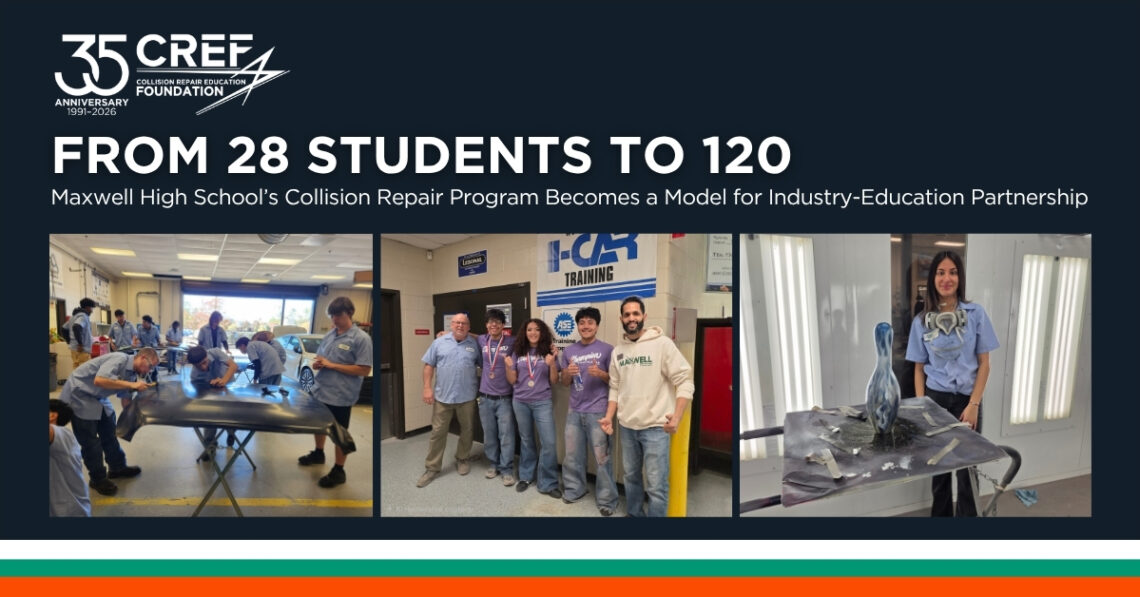
From 28 Students to 120: Maxwell High School’s Collision Repair Program Becomes a Model for Industry-Education Partnership
Curated for the Collision Repair Education Foundation
Fifteen years ago, the collision repair program at Maxwell High School of Technology in Lawrenceville, GA served roughly 28 students. Today, enrollment has climbed to approximately 120 students – a transformation fueled by consistent leadership, industry engagement and a long-standing, three-way partnership with the Atlanta I-CAR Committee and the Collision Repair Education Foundation.
What began as a shared commitment to strengthening collision repair education has evolved into one of the region’s strongest examples of how industry-school partnerships can directly impact workforce development. “The biggest factors were consistency, industry involvement and student success,” reflects recently retired, long-time collision repair instructor Paul Kable. “As the program continued producing skilled students who were employable right out of high school, word spread among parents, counselors and local shops.”
That reputation didn’t happen overnight. Over the past decade and a half, Maxwell Tech has focused heavily on aligning curriculum with modern collision repair standards, emerging technologies and real-world shop expectations – all while maintaining deep relationships with industry partners committed to student success. As the program evolved, so did its relationship with the Atlanta I-CAR Committee, which became a sustained investment in the future of the industry, extending well beyond financial support to include ongoing engagement, guidance and advocacy for student success. Committee members remain engaged through advisory board participation, helping educators identify equipment needs, evaluate curriculum priorities and ensure student training aligns with the skills employers expect from entry-level technicians.
“Our relationship started through a shared goal of improving collision repair education and building a stronger future workforce, but the partnership was different because of the long-term commitment,” notes Fernando De La Cruz, who now leads the program. “The Atlanta I-CAR Committee didn’t just donate equipment once and walk away – they’ve stayed actively involved in supporting students, instructors and program development year after year.”
That continued involvement helped elevate the program’s credibility not only with students and parents but also with school leadership and collision repair employers throughout the region. Direct engagement from respected industry professionals reinforced that students were receiving relevant, high-quality training tied directly to workforce needs. “Their support showed that the industry truly believed in the program,” De La Cruz emphasizes. Having direct involvement from respected collision repair professionals and organizations gave students and parents confidence that the training was relevant and valuable, and it also strengthened relationships with local employers looking for trained entry-level technicians.”
Industry engagement is also visible in student opportunities. The program regularly hosts career fairs, employer engagement events and training sessions that connect students directly with collision repair professionals before graduation. These experiences help students better understand workplace expectations while building early industry relationships. Exposure to working professionals also gave students a clearer understanding of the expectations – and opportunities – waiting for them within the collision repair industry.
Physical improvements to the learning environment have also played a key role in the program’s growth. Prior to Kable’s tenure, Maxwell Tech was selected for a CREF Makeover Award that helped transform the collision repair lab into a more structured, industry-like training environment. The shop floor was refinished, and work zones were professionally striped, improving both safety and organization while reinforcing workplace expectations.
Over time, continued support from CREF and industry partners expanded beyond facility upgrades into equipment, technology and instructional resources that helped sustain and modernize the learning environment. CREF support has included tools such as plastic welders, Pro Spot welding equipment, roll-around tool carts, upgraded air systems and fresh-air supplied respirator systems for the paint booth. Students also train using industry-standard resources, including CCC ONE estimating software and I-CAR Academy curriculum, allowing them to gain experience with the same tools and systems used in professional repair facilities.
“These upgrades have given students experience with industry-standard tools and training,” said De La Cruz. “This has improved readiness and led to stronger internship and employment opportunities, with local employers actively recruiting from our program.”
As those investments took shape and the industry itself evolved, student interest continued to grow, while technological advancements have reshaped students’ perceptions of the trade. “When students see modern repair procedures, ADAS technology, welding certifications, refinishing technology and advanced equipment, they begin to understand how technical and specialized the industry has become,” De La Cruz observes. “Today’s students recognize collision repair as a highly technical career with strong earning potential, advancement opportunities and many specialized career paths beyond traditional body work.”
To meet growing enrollment and increasing industry demands, the program has expanded its curriculum, strengthened employer partnerships and increased hands-on learning opportunities. Second-year students now participate in live repair work, while first-year students focus on foundational skills through structured lab activities and donated vehicles.
The combination of instructional development and industry support has produced measurable workforce outcomes. De La Cruz estimates that approximately 10% of students enter the collision repair industry immediately after graduation through internships, apprenticeships or full-time employment. Each year, the program also celebrates students committing to the trade through a SkillsUSA Signing Day celebration. Local employers regularly recruit from the program, including Hayes Chrysler Dodge Jeep RAM, Classic Collision, Caliber Collision, Gerber Collision, Hendrick Automotive Group and numerous independent repair facilities. These employers value graduates who have already trained on industry-standard equipment, safety systems and estimating platforms. Some graduates have returned to Maxwell Tech to mentor current students and recruit future employees – creating a full-circle workforce pipeline few programs achieve.
“The focus has always been preparing students for both employment and continued education,” Kable stresses, noting that the most fulfilling part of his job has been watching students build successful, lasting careers in the industry. “I’m most proud of seeing students build successful careers and knowing the program helped create opportunities that changed lives. Watching the program grow while maintaining strong industry relationships has been very rewarding.”
As program leadership transitions to De La Cruz, the program remains focused on continuing that momentum while adapting to the rapidly changing collision repair landscape. “I want to continue building strong industry partnerships while keeping the program aligned with modern repair technology and industry expectations,” De La Cruz expresses. “My goal is to continue growing opportunities for students through certifications, advanced training and real-world experiences that prepare them for long-term success.”
De La Cruz sees Maxwell Tech’s growth as evidence of what can happen when schools and industry partners remain committed to a shared vision. Looking ahead, he believes the same principles that fueled the program’s success will continue shaping the next generation of collision repair professionals. “When students have access to modern training, real industry support and clear career pathways, it creates a stronger pipeline of motivated and skilled future technicians.”
That message remains at the heart of the program’s continued success. “The future of the industry depends on investing in the next generation. When professionals get involved with schools and organizations like CREF, students gain valuable exposure, guidance and opportunities that help bridge the gap between education and the workforce,” De La Cruz stresses. He also points out, “Continued collaboration between education and industry will remain critical for developing the next generation of collision repair professionals.”
Ultimately, the success of Maxwell Tech’s Auto Collision program reflects far more than enrollment growth alone. It demonstrates what can happen when educators, students, school leadership and industry partners commit to building opportunities together – and continue showing up year after year to support the next generation of collision repair professionals.
Industry members interested in getting involved and supporting the Collision Repair Education Foundation’s efforts to assist high school and college collision repair training programs can Contact Us to learn about the many ways to get involved. Monetary donations can be made online, or sign up for The Donation Exchange to easily provide in-kind resources that collision repair schools and students desperately need.

You May Also Like

Third Time’s a Charm: CREF Scholarship Winner Takes Gold in Refinishing at 2025 SkillsUSA National Competition
The Best Technology Shouldn’t Be Reserved for Seasoned Painters: DeVilbiss’ Spray Gun Donation Allows Students to Produce a Flawless Finish