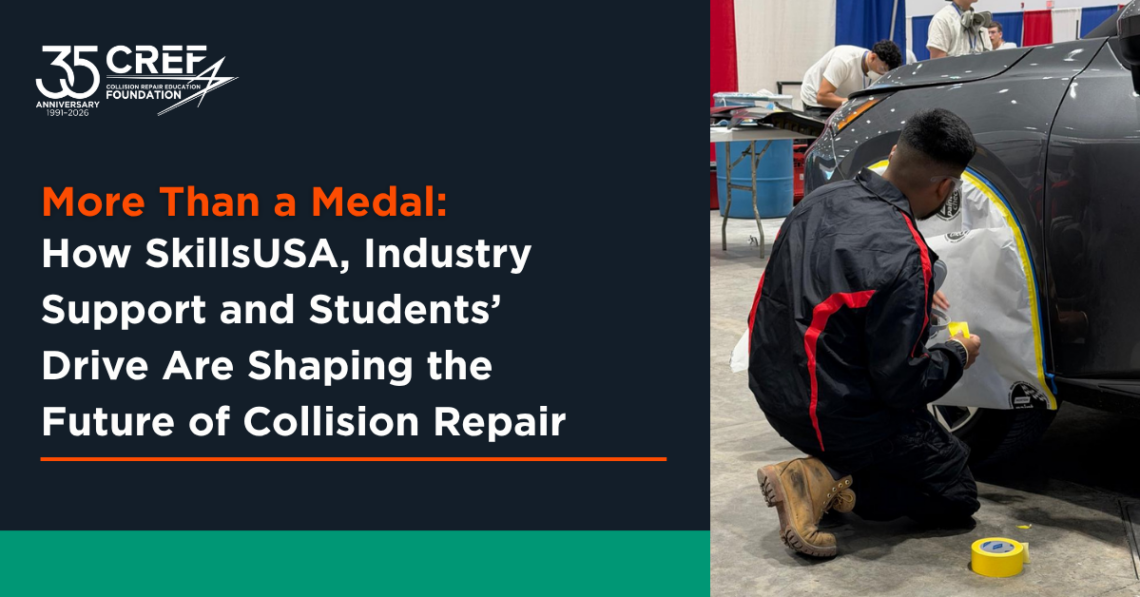
More Than a Medal: How SkillsUSA, Industry Support and Students’ Drive Are Shaping the Future of Collision Repair
Curated for the Collision Repair Education Foundation
Long after the final bell rings at Thomas A. Edison Career and Technical Education High School, the collision repair shop is still alive with activity. Students stay late practicing welds, masking panels or refining spray techniques. Some arrive before sunrise to spend extra hours in the paint booth before classes begin, while others head directly from school to internships at local collision centers where they continue sharpening the skills they first learned in the classroom.
For collision instructor Barry Roopnarine, those extra hours represent something much larger than competition prep. “That dedication is really what sets them apart. It’s not necessarily everything you do in the classroom that makes you successful; it’s also everything you do outside the classroom.”
That mindset helped propel senior Reyaad Mohamed to a gold medal in automotive refinishing at the New York State SkillsUSA Competition this spring, earning him a trip to the national championships in Atlanta. “This will be my third time taking students to nationals, and I never thought that would be possible,” Roopnarine shares. “Just getting there is an honor on its own. The fact that we’ve had two national wins already is amazing!”
Competition has long been embedded into Edison’s culture. “We’re a very competition-driven school,” says Jessie Kalloo, an Edison graduate who returned to teach and now helps oversee the school’s SkillsUSA chapter and career and technical education pathways. “Any competition that’s out there in any discipline, we go in and try to win.”
This year, Edison sent 50 students to the state SkillsUSA championships. Seventeen earned gold medals and advanced to nationals, while five won silver and one captured bronze. Students competed across multiple technical disciplines, including collision repair, refinishing, damage appraisal, automotive service technology, IT networking and graphic arts.
But the competitions are about far more than trophies. “Win or lose, we still take away something,” Kalloo explains. “If we’re losing competitions, we come back and tighten up our program, change our curriculum, bring in the pieces we’re missing. If we’re winning, we know we’re hitting the marks, but we still have to keep it consistent.”
Because SkillsUSA competitions are heavily industry-driven, instructors use them as a benchmark to ensure students are learning current, relevant skills. “It’s 100% industry-led,” Kalloo notes. “If we’re losing because we’re teaching outdated stuff, then we have to tighten that up and bring in new equipment and technology to adequately prepare our students to enter the workforce. These competitions are very helpful for developing our programs.”
“SkillsUSA gives us the guidance and structure we need to get students affiliated with the industry, plus it provides standards to follow,” Roopnarine agrees. “It helps identify what they should know by the time they graduate, and it gives them a lot of exposure to different repair facilities. Involvement from local shops encourages the students and helps ensure they’re receiving a solid foundation to begin an entry-level position in the industry.”
For students, the impact is equally personal. “It has opened me up to experiences I wouldn’t have gotten without SkillsUSA,” said Bryan Lochan, a student leader at Edison.
Chalantica Roy, another student leader, described SkillsUSA as a place where students find connection and confidence beyond the classroom. “It’s given me an outlet to find where my people truly are. You work with so many amazing people, plus Skills provides a platform for CTE students to show off our talent in our chosen vocations and the excitement we have about becoming America’s next skilled workforce.”
For Mohamed, SkillsUSA became a source of motivation almost immediately. “From my sophomore year, I’ve been competing,” he shares. “The first two years, I competed in estimate, and my final year, I participated in the refinishing competition. There’s something about Skills that made me want to do more. It makes me want to compete harder, do my best, win and just keep winning.”
His journey through Edison’s collision program reflects the layered approach Roopnarine has built over the years. Students begin by learning automotive detailing before branching into collision repair, refinishing or estimating. Throughout the process, they are exposed to internships, mentorships and real-world industry experiences.
Mohamed embraced every opportunity available to him. A chance conversation while getting a car wash connected him with an Edison alumnus who now owns a detailing business in Queens, NY, and that simple conversation turned into an internship. Through Roopnarine’s industry connections, Mohamed later interned with Mid Island Collision and then North Shore Auto Body.
“At Mid Island Collision, I learned a lot about advanced prepping and masking techniques, and I also received an introduction to waterborne paint, which really stood out since we don’t have that in the classroom,” Mohamed notes. “In my next internship with North Shore Auto Body, I got exposed to tinting which is another thing we don’t have access to at school, but that’s something I need to learn to prepare for nationals.”
Roopnarine praises Mohamed’s work ethic which shows his dedication to his craft. “He comes in at five or six o’clock in the morning, so he can work in the booth before classes start. If he notices that something needed for a project is unavailable, he quickly finds an alternative way to complete the task. He comes prepared, takes initiative and does not let obstacles prevent him from getting the job done. Reyaad puts in time and effort that goes above and beyond, and he demonstrates the kind of responsibility and ethics that can’t really be taught. All of that is what makes the difference between a competitor and a gold medal winner.”
That commitment has translated directly into skill development. “I have him painting now, and he comes out with work that’s better than what you see in some shops today,” Roopnarine laughs. “He’s far ahead of the game.”
But Roopnarine insists that Mohamed’s medal itself is only part of the story – that success didn’t happen in isolation. Behind that victory, the real story reveals a network of support extending beyond the classroom; it’s about what happens when motivated students, committed instructors, industry partners and organizations like the Collision Repair Education Foundation work together to create opportunities that wouldn’t otherwise exist.
The long-time instructor traces much of the collision program’s growth back to a pivotal moment in 2014, when Edison received a $50,000 makeover award from the Collision Repair Education Foundation. “We’ve come a long way because of the work they do and the support they’ve given us.”
CREF’s makeover award provided tools, equipment and consumable materials that helped stabilize and modernize the program. More importantly, it elevated the school’s visibility within the industry and helped create relationships that continue to benefit students more than a decade later. “Once we won that award, people in the industry became familiar with what we do,” Roopnarine acknowledges. “That exposure allowed us to build better relationships with industry partners.”
One of those relationships began during a CREF ribbon-cutting ceremony, where Roopnarine met Rich Tanchyk, vice president of VIVE Collision. What started as a single introduction evolved into a long-term partnership that has become an important part of Edison’s SkillsUSA success. For the past three years, VIVE Collision has sponsored the New York City SkillsUSA Collision Damage Appraisal competition and helped support the addition of automotive refinishing to the regional event. Through Regional Director Nick Saporito and his team, the company has also provided mentorship, industry engagement and specialized training opportunities for students preparing for competition.
“If not for the networking and relationship-building opportunities provided by CREF, this partnership would likely not have been established,” Roopnarine acknowledges, crediting the collaboration for “strengthening the connection between classroom instruction, SkillsUSA competition and workforce development.”
For Mohamed, that support became especially valuable as he prepared for the SkillsUSA National Leadership & Skills Conference. Through VIVE Collision’s partnership with the school, Saporito helped arrange customized training at M3 Collision Center in New Jersey, giving Mohamed exposure to advanced paint-mixing and tinting techniques that extended his learning beyond what could be taught in the classroom alone.
VIVE Collision is just one example of the industry network that has grown around Edison’s collision repair program over the past decade. Through partnerships cultivated with the support of CREF and strengthened through SkillsUSA participation, students regularly gain access to internships, mentorship, donated materials and real-world training opportunities that would otherwise be difficult for a high school program to provide.
The relationships developed through CREF continue paying dividends more than a decade later as additional companies, including Gotham Collision and LKQ Corporation, continue to support Edison students through internships, donations, mentorship and competition preparation. Local businesses donate vehicles, paint materials and replacement parts that allow students to complete projects from start to finish.
Industry professionals also help judge Edison-hosted SkillsUSA competitions, giving students direct feedback from working technicians and managers. “For them to take time out of their day and dedicate somebody to work with your students, we’re really appreciative of that,” Roopnarine applauds.
The support extends beyond current students. Many Edison alumni now return to mentor, hire and train the next generation. “That’s one of the greatest things about what we do,” Roopnarine points out. “Students leave, they become successful, and then they turn around and give back because they believe in what we’re doing.”
That philosophy is not abstract for Roopnarine; it’s personal and evidenced by his own journey. An Edison graduate himself, he now teaches in the same halls and shops where he once trained, embodying the very cycle he describes: students becoming professionals, then returning to shape the next generation.
That full-circle impact is already visible in Mohamed’s journey. His internship at North Shore Auto Body was facilitated by a former Edison student, Dereck Chetram, a gold medalist in the 2021 SkillsUSA National Collision Damage Appraisal competition, who now works in the industry. “Dereck is already giving back,” Roopnarine says. “He actively supports our collision repair program by providing hands-on training and industry-based demonstrations. He serves as a mentor to both SkillsUSA competitors and classroom students, sharing his expertise in collision repair processes, damage analysis and ADAS, which helps prepare students for success in both competition and the workforce.
“It trickles down,” he adds proudly. “Our alumni are now helping the current students.”
As the collision repair industry continues facing technician shortages nationwide, programs like Edison’s are becoming increasingly important pipelines for future talent, and Roopnarine believes the key is giving students real-world experience through internships and by bridging the gap between the classroom and the shop. “When the industry gets to see what students are doing, interact with them and evaluate them, that’s huge,” he insists.
Edison’s administration has also invested heavily in expanding career and technical education opportunities. What was once a one-year collision program has grown into a three-year pathway, giving students more time to develop specialized skills and explore multiple career options within the industry. Whether a student pursues detailing, painting, estimating or structural repair, the goal remains helping each student identify a pathway that matches their interests and strengths while developing real-world professionalism along the way.
For Roopnarine, that preparation matters more than any single competition result: “A medal doesn’t make you successful. It’s great to have, but you have to look at the bigger picture – what you got out of it.”
That bigger picture is visible every afternoon at Edison, when students voluntarily stay hours after school ends to keep practicing. It’s visible in the alumni who return to mentor younger students. It’s visible in the industry partners willing to open their shops and invest time into training teenagers. And it’s visible in students like Mohamed, whose gold medal represents not just individual talent, but an entire network of support designed to prepare the next generation of collision repair professionals.
When Mohamed heads to the SkillsUSA National Leadership & Skills Conference this summer, he’ll carry more than Edison pride with him; he’ll represent what can happen when education, industry and opportunity align – and when a student is willing to put in the work long before anyone is watching.
Industry members interested in getting involved and supporting the Collision Repair Education Foundation’s efforts to assist high school and college collision repair training programs can Contact Us to learn about the many ways to get involved. Monetary donations can be made online, or sign up for The Donation Exchange to easily provide in-kind resources that collision repair schools and students desperately need.